130
MLBLUE
FALL2016
BACK
PAGE
words :: Dan Rubinstein
I slam the tailgate shut, drive out of my
neighbourhood in semi-suburban Ottawa, and
10minutes later park at a beach on the Rideau
River. For eight years, ever since moving to the
city, I experienced only the periphery of the
waterway: walking, running and cycling in all
seasons along the trails that line the shore, and
XC skiing atop the frozen surface whenever the
temperature plunged low enough. Then I got
a stand-up paddleboard, a loaner iSUP Ten-Six
fromMEC, made by Ottawa-based Level Six.
Although it’s a hefty 10.5 feet long, with a 32-
inch deck, the inflatable fits insidemy van when
pumped full, whichmakes it easy to zip out to
the river. Which, with no hyperbole whatsoever,
has changedmy life.
The obsession took hold the first time I stepped
onto a SUP, a rental on a lake at a provincial
park. An hour of lazy paddling and drifting on
a sunny afternoon, and a series of quick swims
to cool off. I was hooked. Wherever I travelled
over the summer, I found a way to get onto
the water: Lac Monroe in Quebec’s Laurentians,
Saskatoon’s South Saskatchewan River,
Waskesiu Lake in Prince Albert National Park,
Bras d’Or Lake on Cape Breton Island, Kootenay
Lake in Nelson, B.C. River or lake, rain or shine,
a workout or chilling out, a gentle glide or hard
into the salt swell, it didn’t matter—despite my
heretofore landlocked life, I felt balance. A new
perspective, a new stance. Feet firmly planted,
knees loose, ready to roll.
Then I got home and settled back into habit,
crossing the river regularly but rarely doing
more than tracing the shore. Until that SUP
arrived in the mail, a box that seemed too small
for all that it could release. I have canoed and
kayaked before, mostly cottage-country lakes on
the former and ocean coves on the latter, but
something about paddleboards—the portability,
perhaps, or the lack of gunwales—makes them
feel entirely different. You’re standing a few
inches above the water and, like XC skiing, can
go pretty much anywhere, as long as there’s
sufficient draft.
My first SUP outing in Ottawa was on a rocky
stretch of the Rideau. The water was low, but
I removed the fin and zigzagged outcrop to
outcrop toward a set of rapids until bottoming
out. I held a branch and rested in the shallows
for a fewminutes, then reversed course for the
ride back. The next night, one of my daughters
joinedme and sat cross-legged on the front
of the board as we set off upstream in a deep
channel. The clouds turned crimson andwe
changed positions, the kid paddling us back to
the beach. A couple days later, I went for my first
lengthy excursion onmy home river, departing
from a Parks Canada lock station on the southern
fringe of the city and cruising into the bedroom
village of Manotick. There weremansions and
muskrats, shade willows to snack under,
kayakers towave to, and surfable waves from
passing outboards. I thought about stashing
the SUP and finding a pubwith a patio but
didn’t want to leave the water.
Now it is autumn. The sun sets early, the swims
are shorter. Normally I’d be thinking ahead to
XC ski season. Instead, I’m researching wetsuits
and water levels. I’m slamming the tailgate shut
and driving down to the river. New perspective,
new stance. Floating atop the flow.
Dan Rubinstein is the author of
Born toWalk:
The Transformative Power of a Pedestrian
Act
. He would love to write a book about
paddleboarding but fears that might spoil the
fun.
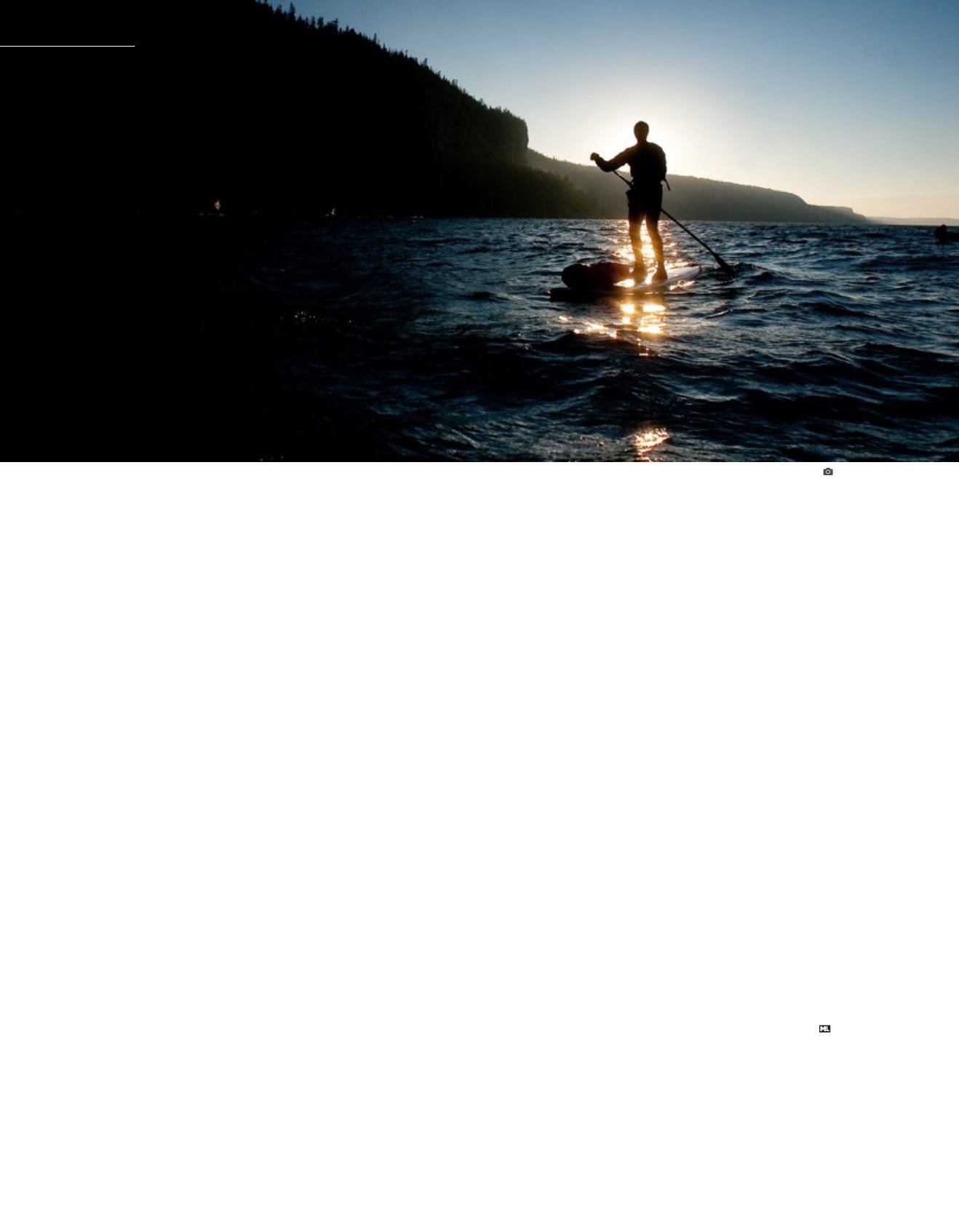
I felt balance. Anewperspective,
anewstance. Feet firmlyplanted,
knees loose, ready to roll.
SUP-STANCE
David Loopstra off theBruce Peninsula,GeorgianBay. GLENHARRIS


