54
MOUNTAINLIFEBLUEMOUNTAINS
SUMMER2016
SUP
FREEDIVING:
8WAYSTO
PREPARE
HOWTOUSEASTAND-UPPADDLEBOARDTOEXPLORE
UNDERWATERWORLDS
words :: Scott Parent
As soon as a conversation about freediving begins, two things usually
arise. People often ask, “How long can you hold your breath?” or “How
deep can you dive?” I find the answers so far have been, “Long enough,”
and “Deep enough for the goal.”
People also ask if it’s dangerous. Not unlike anything else we take up in
the outdoors, “It can be.” There are inherent risks involved. So when we
explore the questions of how long and how deep we dive, we have to
weigh our experience level, just like any other outdoor activity. To say that
I have dived to a certain depth does not mean I will be able to reach that
depth again tomorrow in different conditions. For the beginner, do not
worry about how far or how long.
We should not be exploring our limits without proper support systems
in place. To introduce yourself to freediving (also known as breath-hold
diving) it is best to learn from someone who is qualified to teach you.
Freediving is not required to be deep and dangerous. The golden rule is
having a good time, on and in the water. Stand-up paddleboards (SUPs)
are easy to anchor close to dive sites, and can raft up easily. They are
much easier to remount on-site, and can be trusted not to capsize while
you’re in the water.
The intro to freediving begins with snorkelling. Where SUP, snorkelling and
freedivingmeet is the surface of the water, so let’s start there.
HOW
TO
Freediving isnot required tobedeepand
dangerous.
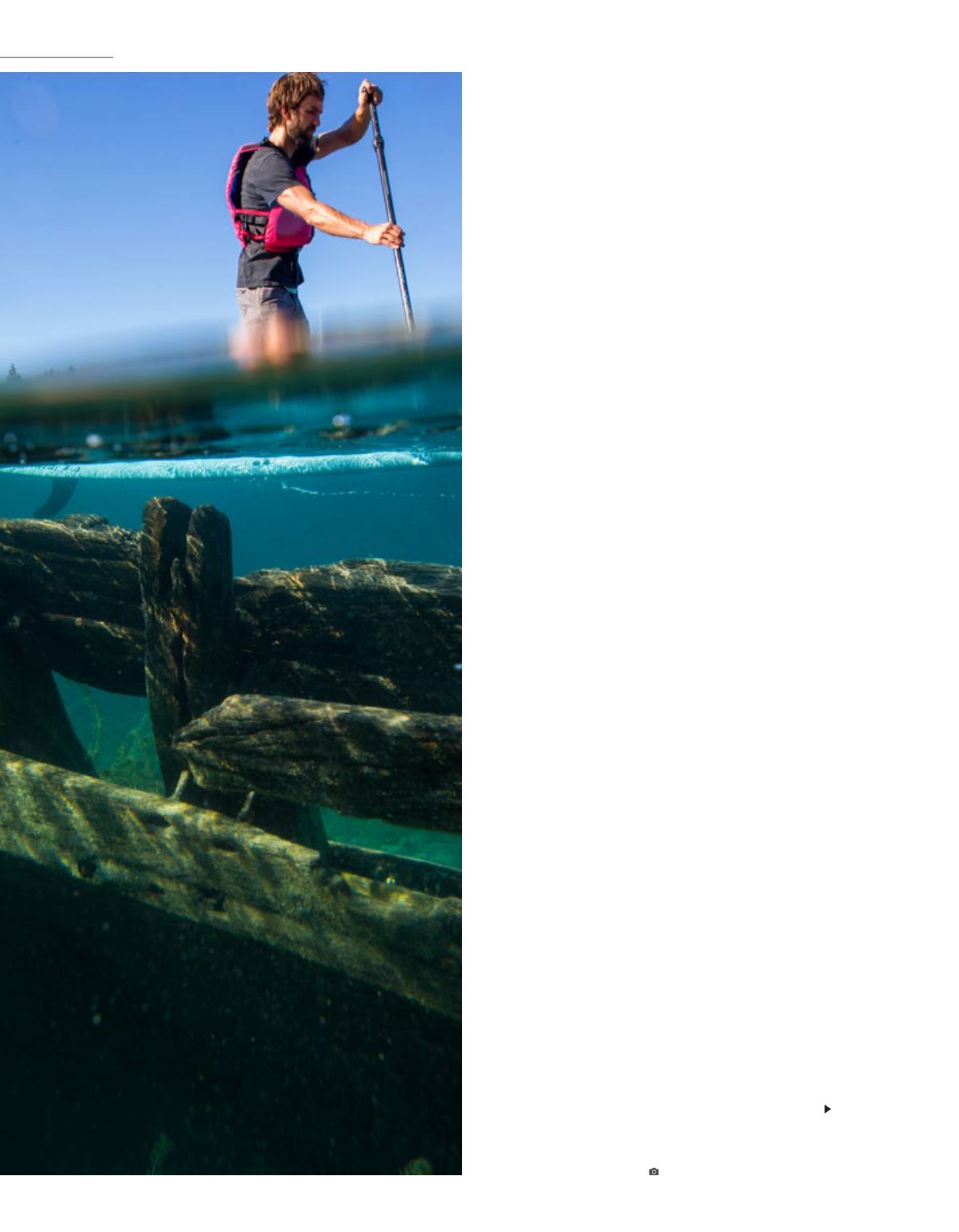
Preparing toexplorewrecks offTobermory. COLIN FIELD


