90
MLBLUE
WINTER2017
Though brain worm doesn’t affect deer (it lives benignly in the connective
tissue around the brain and spinal cord), the parasite has a typically
complex life cycle: worms release eggs that hatch in the deer’s lungs;
coughed up, swallowed and excreted, the larvae find homes in snails and
slugs. By accidentally consuming these mollusks while grazing, 90 percent
of all deer are infected in their first two years of life. In areas of deer
abundance, moose pick it up, too. But brain worm isn’t happy inmoose,
burrowing around in search of a deer brain it never finds. Not only are
moose dead-end hosts, they’re also usually dead. (On Lake Superior’s Isle
Royale—free of deer and thus brain worm—the trend is opposite: collapse
of the local wolf population from inbreeding causedmoose numbers to
soar. As on predator-free Newfoundland, the irruption threatens to exceed
carrying capacity by wiping out its main food, balsam fir, demonstrating
why predators are critical to holding prey populations in check and
keeping forests healthy.)
Ditto for winter ticks, another devastating pest moved around by
cervids like deer and elk. Larval ticks climb ontomoose in the fall and
feed themselves into adulthood over winter. Moose with particularly
heavy tick loads—over 100,000 counted on one decidedly miserable
Ontario animal—can’t eat enough to replace the blood loss, and end up
cannibalizing their ownmuscle tissue for protein before, inevitably, dying.
These proximal parasite issues, however, share the same underlying
cause: climate change. Brain-worm carrying deer populations expand
with shorter winters and longer growing seasons, and tick populations
explode with earlier snowmelt. Historically, deep winter snow kept deer
frommoose country, with less opportunity for the species tomix. But
warmer winters have allowed deer tomove north into boreal forest in the
East, and to higher elevations in theWest, where their greater prevalence
boosts populations of predators that are alsomore than happy to prey on
moose calves.
One apex predator in particular is affecting calf survival. Ontario’smoose
population has declined rapidly over the past decade, warned the province’s
Environmental Commissioner Dianne Saxe in a November 2016 report that
urged government to take better care of the province’s wildlife and forest
resources just as hunting season for adult moose and calves got underway
in northern Ontario. “Moose are key forest species inmost of Ontario,”
Saxe told the
TorontoStar
, recognizing the combined impacts of loss of
roadless areas, fire suppression, disease and hunting. “[And] climate change
ismaking it worse—moose are exquisitely adapted to coldweather and
very poorly adapted for heat… there are now an estimated 92,300moose
[there]… a decline of about 20 per cent over the last decade.”
Hard-hit areas include Thunder Bay and Cochrane, where moose are down
50 and 60 percent, respectively. Saxe also suggested hunting rules for
calves are too lax, noting that “every single one of the 98,000 licensed
moose hunters in Ontario is allowed to kill a calf every year—that’s more
than three times as many hunters as there are calves even born.”
Ontario responded to declines two years ago by launching aMoose Project
looking at ways to reduce pressure onmoose and restore populations
(ontario.ca/page/moose-population-management). And while this has
included changes to the hunting season, more clearly needs to be done.
Other recommendations frommoose-management advisory committees?
Hammer deer through any means possible. And yes, they used that word.
The problemwith hammering deer, however, is that they’ve proven adept
at hammering back. Much like humans, deer modify the habitat they
occupy and eliminate biodiversity, though not to their own immediate
detriment. And when habitat quality declines, they simply move to a new
area—or swim to one.
Look out Newfoundland.
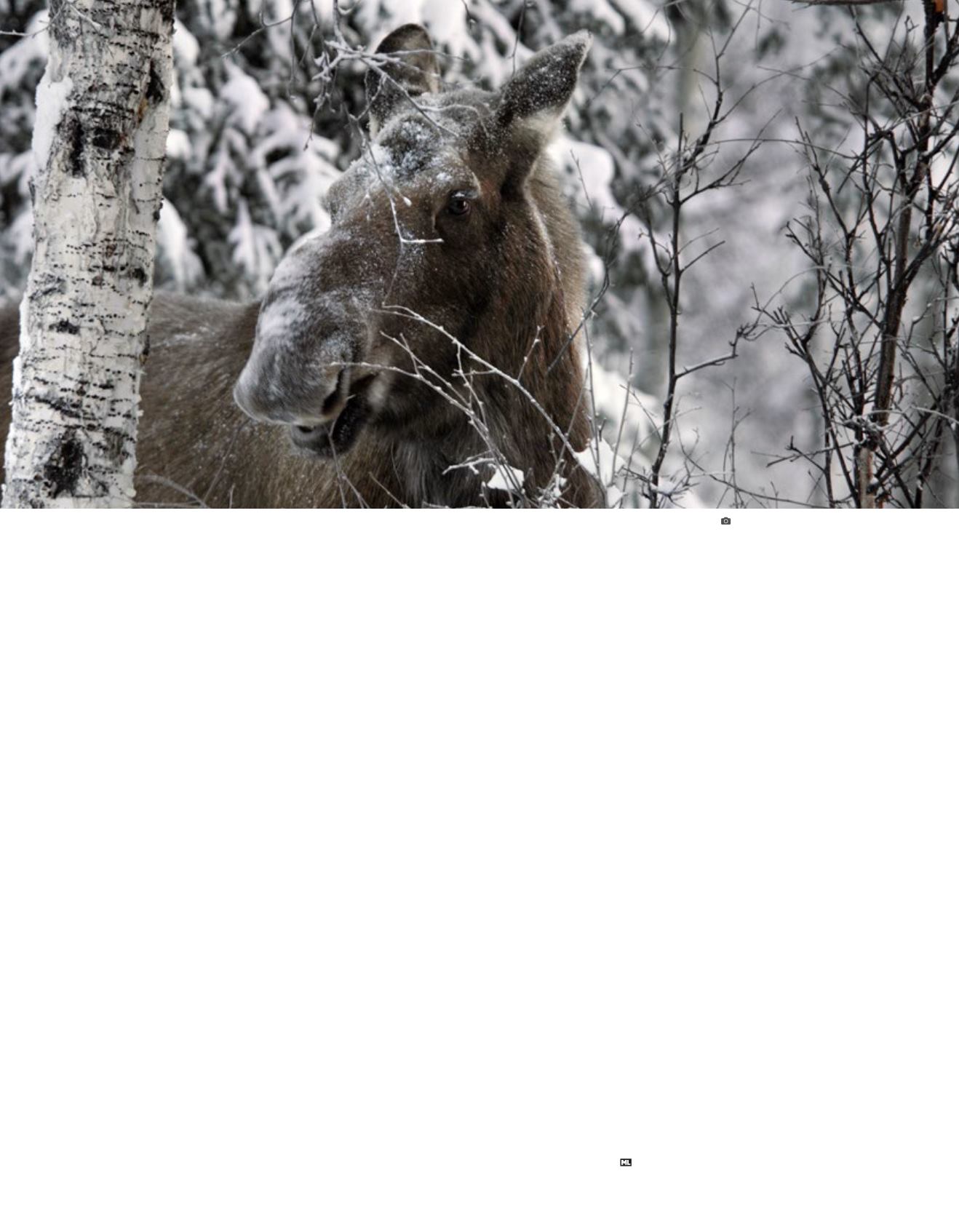
"Mooseareexquisitely adapted to coldweather and verypoorly adapted for heat…" USNATIONALPARKSERVICE/TIMRAINS


