100
MOUNTAINLIFEBLUEMOUNTAINS
FALL2016
air, a few porters clap. Dropping my pack and
then collapsing on top of it, I lie back in the
sun and close my eyes.
Others begin to arrive. One woman is struggling
with the last few steps—when she reaches the
top, a fellow hiker runs over to her, grabs the
sides of her face and hugs her. New to hiking,
this is the hardest trek she’s ever done and
her victory makes me cry. Then I laugh when
another, a quiet demure lady, raises her poles
and bursts out: “That was f***ing awesome.”
Day three was almost entirely downhill, but also
the most scenic. Passing under low-hanging
Spanishmoss, and red bromelius flowers,
sometimes the fog seems to swallow the entire
forest—and for most of the day, I’m alone on
this floating trail in the clouds.
Arriving first at the campsite, the fog has
cleared. Walking to the edge of a cliff, I expect
to see more mountains; instead, I see the
Phuyopatamarka ruins below—more terraces
and reminders of people gone for somany
centuries. When earthquakes and landslides
have destroyed newer buildings and entire
towns, these remain.
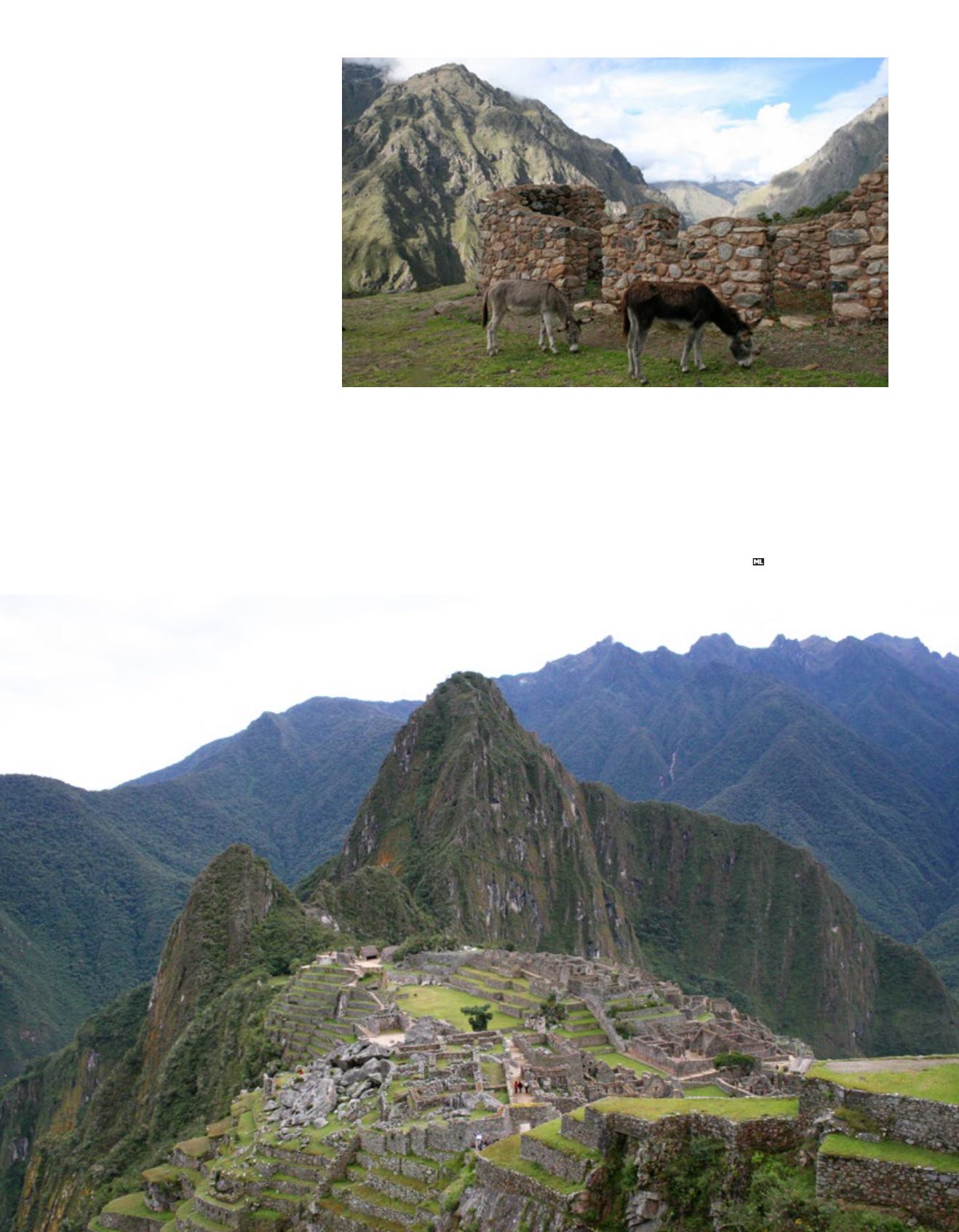
Day four leads us toMachu Picchu. Walking on
a diagonal downhill, we all began arriving at
the Sun Gate and wait for the fog to clear: on
June 21 of every year, the solstice sun passes
through a trapezoidal opening in the gate and
down ontoMachu Picchu’s Temple of the Sun.
Today’s fog was persistent.
Eventually, it clears near the site. I didn’t know
what to expect: what’s the big deal considering
everything I’d already seen? And here it is. The
Lost City of the Incas. Millions arrive here every
year, but somehow this moment is mine. I keep
shakingmy head in disbelief repeating, wow,
wow, wow. Perfect stone blocks fitted without
mortar; green skyscraper mountains piercing the
clouds. I can’t wait for the others to arrive—it’s
too good to not share.


