106
MLBLUE
FALL2016
words :: Nelson Phillips
Autumn and early winter are times of contrast.
As seasons change, the Great Lakes undergo
immense temper tantrums, mythologized by
the First Nations in the wrath-ridden legends of
Kitchikewana
, an angry lake spirit responsible
for creating the 30,000 Islands of Georgian Bay,
and
Michi Peshu
, a magical lynx-like creature
said to live underwater. Wary of the water, First
Nations offered prayers and ceremonies before
entering their canoes. But like the huge swells
and gales the Greats are known for, there is
another mostly forgotten phenomenon—a
dangerous and unpredictable “tide” active in
the bays and inlets of these freshwater seas.
First observed in Lake Geneva, Switzerland in
1890 by hydrologist François-Alphonse Forel,
a
seiche
—nicknamed a “freshwater tide”—is
a standing or oscillating wave in an enclosed
or partly enclosed body of water. A seiche is
caused by resonances in a lake disturbed by
one or more key factors, including high winds
and seismic activity. Because gravity is always
seeking to restore the horizontal surface of a
body of water, a seiche represents the struggle
of the lake to return to a state of hydrostatic
equilibrium, or balance. Think about the last
time you raised a glass of cheer only to have
your pint slosh back onto your arm and sleeve;
that displaced beer must return to a balance—
how gently or violently is determined the
magnitude of your “cheers.”
W. Sherwood Fox’s book
The Bruce Beckons
describes a 1945 seiche known locally as “The
Day of the Great Tide” by locals of Tamarac
Island near Stokes Bay on the Bruce Peninsula.
The book describes the “amazement that a
scene of such violence as one usually associates
with a tempestuous ocean could occur on an
inland lake,” as locals scrambled to head off
the water rushing back between the shore and
the island's eastern shoal, as Lake Huron rose
18 inches in 20minutes. Fox adds: “Nowhere
else in the Great Lakes have I ever found a spot
where one can view so convincingly the reality,
the constancy, and the irresistible power of the
secondary seiche of a freshwater sea.”
In 1954 on LakeMichigan, a near 10-foot seiche
devastated the Chicagowaterfront and swept
eight fishermen to their deaths. In July of 1995,
a seiche on Lake Superior causedwater levels
to rise and fall by about three feet in fifteen
minutes. That same storm system rocked Lake
Huron to the south, where thewater levels in
some places rose by six feet in under two hours.
Around Christmas of 2014, a seiche that hit
Buffalo elevated Lake Eriewater levels by 5.5 feet.
“It’s astounding,” says Gail Faveri, a manager
for Environment and Climate Change Canada.
“People see the water level go up and then they
see the water level go down, so they go out
on the beach and they don’t realize it’s going
to come back again—then they get washed
out.” Destruction aside, is a seiche surfable?
While not recommended, in a word: yes. “If
you’re skillful enough,” says Faveri. “With the
right combination of length of the lake in the
direction the wind is blowing, and the average
water depth, the return oscillation can combine
with the wave from the other direction and
double themagnitude…if the wave hits and
bounces at the right place, it could be amirror
image. It will amplify [the wave] twice as big.”
Great Lakes surfer James Carrick adds to the
“whoa” factor by reminding us that while
surfable waves in the Greats are made by
wind, it doesn’t take much to churn them up.
“Anything 3 feet or bigger is rideable on a
longboard. I know a lot of people don't know
how big our waves can get, but when they
say they didn't know they were big enough
to surf, I tell them you can technically ride a
3-foot wave—and they get bigger than that. A
lot bigger. Winds onshore of 20-30km/hr can be
enough to generate a rideable wave.” To put
that into perspective, the 1975 November storm
in Lake Superior that sank the
EdmundFitzgerald
reportedly produced hurricane-strength winds of
90-138km/hr.
Lake Erie is especially prone to seiches due to
its shallowwater and elongated shape that runs
east to west with the prevailing winds. Seiches
in Erie, and in all the Greats, can create havoc
and destruction—and sets of drool-worthy
surfable waves.
These savagely subtle freshwater tides occur
more often than we’re aware. Like Mavericks in
California, Teahupo’o in Tahiti, and Jaws inMaui,
eventually a mammoth Great Lakes seiche will
have to be surfed.
PERFECTSTORMS
HOWANOBSCUREWEATHERPHENOMENONMAYONEDAYCREATETHEULTIMATEGREATLAKESSURFINGWAVE
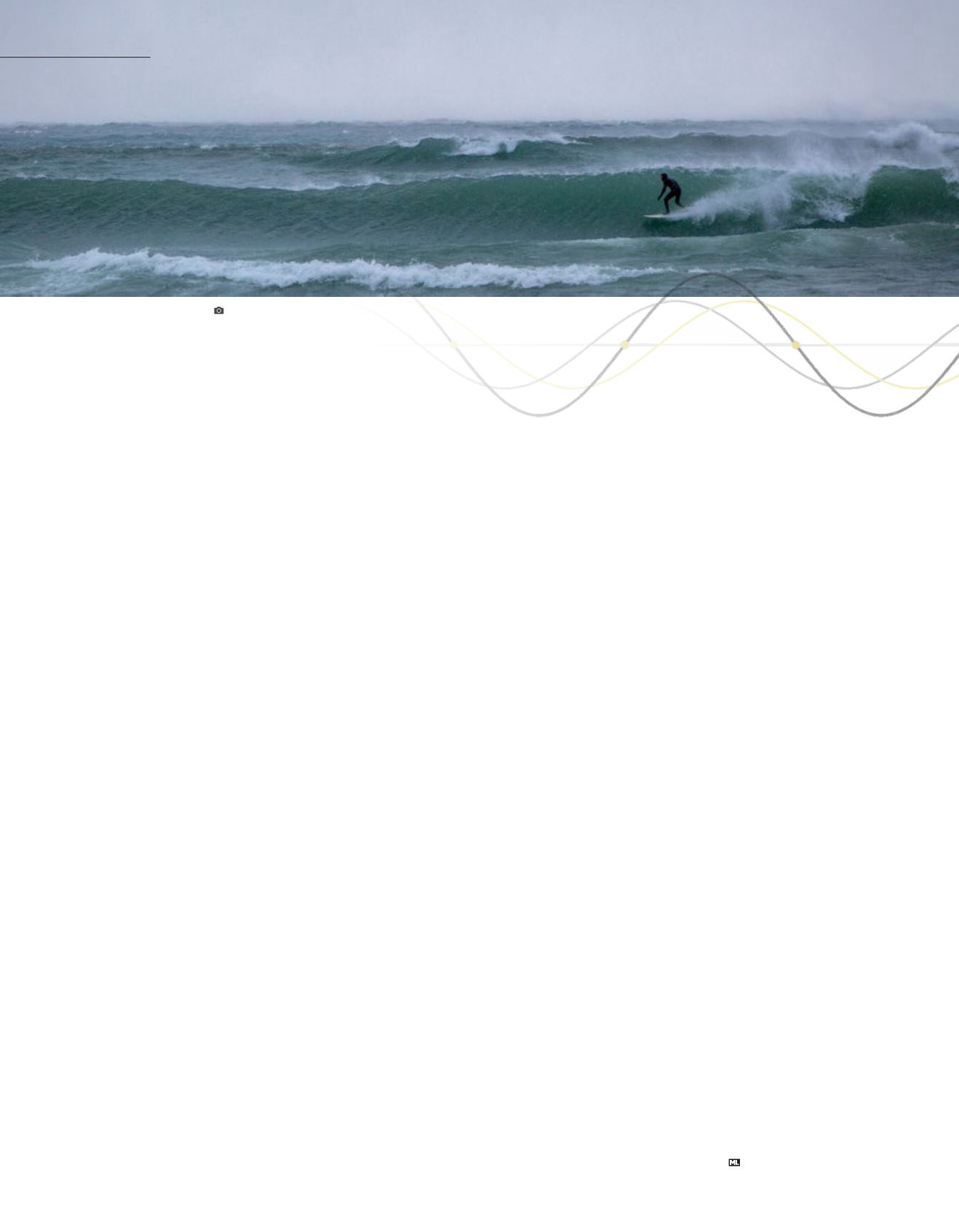
Surfing LakeMichigan; spot the seiche. COURTESY
GREAT
LAKES


