78
MLBLUE
FALL2016
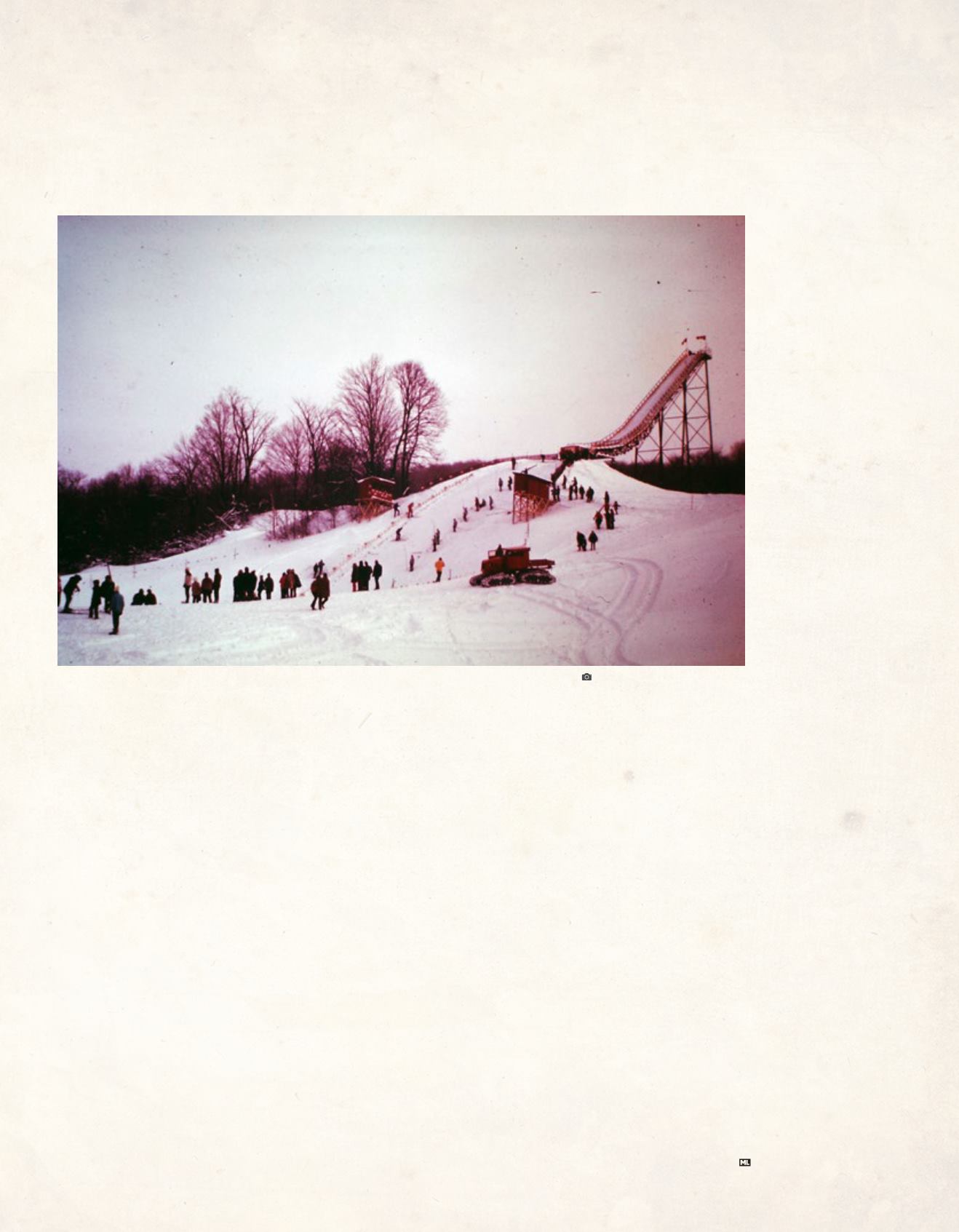
The 1970/71 seasonsaw the launchofBlue’s
highest-ever ski jump; since theearly‘50s,Bluehad
constructedseveral jumps, butnoneapproaching
thiscompetition-readymonster. FormerBlue
MountainResortPresident,GeorgeWeider, sonof
BlueMountainResort founder JozoWeider, recalls:
“Jozo wanted an international-calibre jump. Near
the end of his life he organized construction of
a 100-metre jump at the south end of the resort.
As this one was more than three times the size
of the earlier Apple Bowl jump, it needed steel
girders, which Jozo purchased second-hand from
Tepermans, the demolition experts in Toronto.
In 1971, Jozo activated the new jump by
staging the North American Championship
there. The meet generated major publicity and
a large crowd of onlookers from the resort
and Collingwood. But competitions of this
stature were costly to organize, and later in
1971, Jozo, who was the keenest supporter,
died in a car accident. The jump was seldom
used after that. Finally, it was torn down
because thrill seekers had been climbing up
the tower.
To become proficient in ski jumping you had
tomake repeated climbs up the jumping hill
and up the tower and leap off again and again
until you could develop sufficient distance and
form. Both for practice and competitions, it
was mainly the jumpers themselves who had to
tramp and smooth the landing hill and shovel
snow on to the in-run and the takeoff ramp.
Jumpers in the 1950s wore heavy wooden skis,
more than 220 centimetres in length, with four
grooves cut into the bottoms to provide straight
running for takeoff and landing. Unlike Alpine
skis, they had no steel edges, as no turns
were required except to brake to a stop after
completing the jump. Points were awarded for
distance and style, and some of the jumpers
went to great lengths with their appearance.
In the 1950s many wore dark blue or crimson
Norwegian ski sweaters with a white stripe
bordering the V-neck. Those who were especially
anxious to impress the judges also wore white
shirts and ties, which were elegantly set off by
the V-neck and stripes on the pullovers. None
of these sartorial effects, however, couldmake
up for style points lost on a mis-timed takeoff,
loss of balance or windmilling in flight, or a
ragged landing. For the proper Telemark landing
one knee was deeply bent just after impact with
that ski slightly behind the other, to absorb
the shock and be poised for a graceful descent
down the remaining part of the jumping hill. At
most meets each competitor made two jumps,
with the best leap counting in the final scoring.
Ski jumping has long been extinct in these
parts, but freestylers and snowboarders can
take air at terrain parks and half-pipes, with
easy access by high-speed lifts. Favouring
casual and loose fitting clothing, they wouldn’t
be caught dead in the fastidious get up of their
airborne counterparts of earlier years.”
Excerpted from“Jozo’s Jumps”,MountainLife
issue6,Winter2005
.
Vintage Air
LONGBEFORETERRAINPARKSANDHALFPIPES,BLUERAISEDAWORLD-BEATINGAERIALFEATURE
Competition-ready: ski jump circa '71. COURTESYBLUEMOUNTAINRESORTS


